Decoding Human Relationships with Result-Oriented Mindset
- Published on
- 8 min read

I feel like I'm obsessed with 'observable's.
At CSTL, my mentor was working on a project to simulate the social network interactions by populating it with bunch of AI agents with different personalities (and therefore try out different moderation strategies on a simulated environment) - but she was missing the 'observability step' in her pipeline. I couldn't figure out how to measure the success of what she was doing, so I started by pinning down the observables in the pipeline.
Now I'm trying to figure how relationships work (like a machine who's been recently re-introduced to the world of human emotions). One thing I realized is that me being a result-oriented person makes it hard to process the relationships.
Being result-oriented, in my perspective, means that you pin down a specific goal or set a definite success criteria and work towards bringing the success metric towards that value. It has worked in several occasions - getting a good GPA (where grades are your success metric) is the most trivial one. Visiting Switzerland (where you measure progress by several factors including the financials, immigration formalities, etc.) is another example where I applied the same result-oriented mindset. Now on the career level my most appreciated example is how I taught myself to become full-stack software engineer (the goal was to become senior programmer by the age of 18) - here the measurement metric I used was 'how well you can build and guide'.
Assuming that I'm indeed a result-oriented learner it makes sense to have difficulty in learning quantum computing - because what's the result? Understanding quantum computing? - no, not my goal. Applying quantum computing? - yeah, that sounds more like it. But what's the measurement metric? - 'how well I apply quantum computing'? This could be used as a metric but the only problem is that I can't measure how well I apply quantum computing myself (so I need external help from QC community for that I guess). The point is that I don't know what a successful quantum computing engineer is like (so I can't pin that down and walk straight towards it).
Coming back to decoding the relationship logic - it's the same difficulty I face in there. I can't imagine how a successful relationship is like for me. Applying the same procedure would require me to have a success metric - is it 'how happy me and my partner are in a relationship'?. Apparently not. If you choose the happiness level of the parties involved as a success metric of the relationship then you are saying that only those who are together and truly happy at the same time have succeeded in their relationship. You should not, however, forget the ones who are together, not exactly happy all the time and yet somehow successful from an external perspective. So the happiness is not a success metric in a relationship, yet I need such metric if I am to understand it.
Another very important thing to consider when choosing a metric is that it has to be something that you have control over (not something out of your control) - that way you actually can work towards success by iteratively refining the metric measurement. Whereas if it's something out of your control you may end up failing because of someone else even though you put your maximum effort to be successful.
Now that I mention the effort, I wonder - why can't we choose 'the effort' as our success metric? I can control how much effort I put into a relationship therefore it's indeed individually manageable. But if that were the case, then you may as well be just sending a gift to your crush each day and say that "I've put so much effort, I therefore have successful relationship" when in fact your crush ends up marrying someone else. So we have to appreciate and accept the fact relationship success will have to be dependent on both parties, not just you. If you try to formulate it, it may look something like:
Relationship Success = (Your effort) x (Partner's effort)
This accommodates for the case I've described above - say your effort is at 1 (max) but your crush has no response (effort ~0), so the success will also end up being low. Yet turns out effort is not all it takes to accurately define the successful relationship. Otherwise the profession of LMFT (Licensed Marriage and Family Therapist) would not exist. Imagine a couple where each person is trying their hardest from their own perspective to make the relationship work and yet it somehow is not fruitful. So we are missing some factor in our formula:
Relationship Success = (Your effort & feelings) x (Partner's effort & feelings)
I say it's feelings, but it may be better-explained when it's 'feeling content'. This ends up giving us 4 variables to observe:
- A-1. Your effort
- A-2. Your feelings
- B-1. Partner's effort
- B-2. Partner's feelings
What a computer science student likes to do when he sees 4 variables is make a truth table out of them:
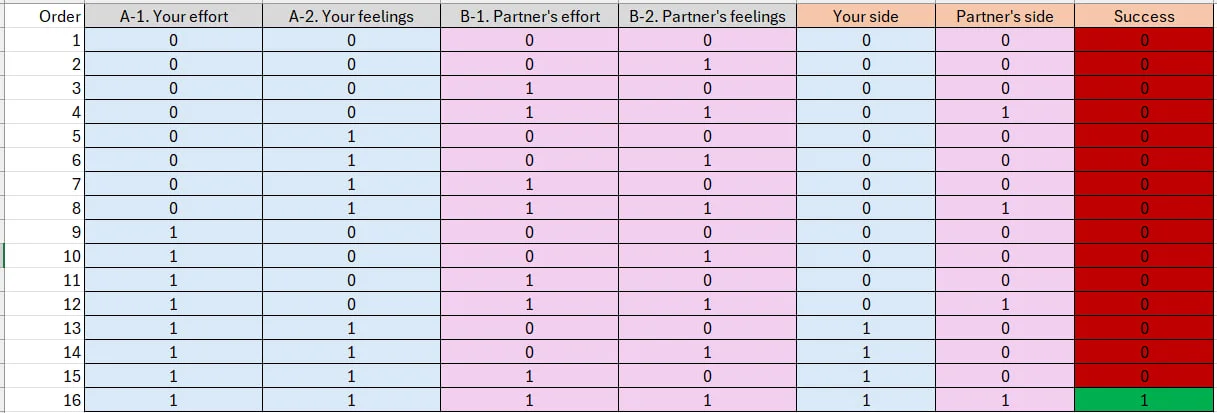
You can see that if you quantize the variables (assuming they can only be 0 or 1, but not something in between like 0.5) - then out of all possible cases there's only 1 with certain success guarantee.
Those variables - you can measure A-1 and A-2 yourself (because you possess them), you can estimate the B-1 (since you can observe majority of the effort you partner puts into a relationship), BUT you can not measure nor estimate the B-2 (Partner's feelings) by yourself. What you can do to also know B-2 is to ask your partner directly but even in that case it's possible your partner is so nice that you end up getting a false positive. What quantum computing enthusiast likes to do is to define B-2 as a random variable - something you can not be certain of but can still estimate an expectation value for. B-2 is complicated because it involves uncertainty and external factor, let's step away from that for now. Let's recall what I proposed as a relationship success:
Relationship Success = (Your effort & feelings) x (Partner's effort & feelings)
This somehow lead to me implying that out of 16 cases, only 1 works out. But I do not mean to do that - after all the whole table was constructed assuming the quantization of values assigned to variables I came up with (so many assumptions I built upon). Though it is somewhat enough to appreciate the fact that relationship is bound to be uncertain (think of impossibility of ruling out uncertainty from B-2) and that it's normal for relationships to not qualify as 'relationship success = 1' (max value, green one). Drawing out these conclusions it's now safe to disregard the whole formula thing itself and make final statement about adapting the result-oriented mind to process a human relationship.
I have stated that for a result-oriented mind two things are important:
- the end-goal / success criteria
- measurement method / the success metric
As far as I can make out for a relationship a reasonable success metric involves factors from both parties and includes individual efforts in it. Now how about the end-goal - what should it be? What does 'relationship success = 1' mean? From the formula above it would happen if both parties put the most effort and both feel content at the same time. Should that be end-goal though? I think not.
I personally think the end-goal should factor yourself more rather than trying to have equal consideration. It may include the factors for:
- self-discovery: learning more about your own preferences, principles
- information: gathering clear data to potentially benefit later on (e.g. in case it does not work out, you may recognize the pattern later again and avoid it)
- boundaries: maintaining boundaries while engaging in a relationship (e.g. career, studies, morals, etc.)
Those factors should be considered because even if the parties do not end up together, they may still be successful in their own terms - one learning more about themselves, the other practicing healthy boundaries, for example. My naive 4 variable formula most assuredly missed all those factors so it still does not hold as an accurate metric - meaning I may come back to this when I want to decode this thing called 'relationship' later again.
Moral of the story / TLDR: Gotta practice defining the end-goal, the measurement metric and executing a relationship just like the other things.